
Midnight Buildathon · Wave 1
Credibility you can prove.
A verifiable credibility layer for online publishing,
built on Midnight.
The problem
Publishing online is easy.
Proving credibility is hard.
- A post can come from a journalist, doctor, accountant, engineer, news outlet — or anyone.
- Readers have no portable way to verify what a source can legitimately claim about itself.
- Trust signals are fragmented: platform badges, screenshots, reputation, manual research.
Vero focuses on one narrower problem:
making source credibility provable.
The solution
From "an authority says so"
to "a proof says so."
Source holds a credential (journalist, professional, organisation)
Compact circuit proves the credential is in the issuer registry, and unexpired
Source discloses only what it chooses
Reader sees a cryptographically verified signal
Identity and credibility are separate dimensions.
Why Midnight
Why Midnight?
- Selective disclosure — prove "this publisher is credentialed" without exposing the credential
- Compact — ZK circuit complexity abstracted into TypeScript-like code (matters for design-led teams)
- Dual-ledger model — private witness data stays local, only verified outcome is anchored publicly
This is the exact primitive the problem needs.
Demo
Verified badge, on-chain.
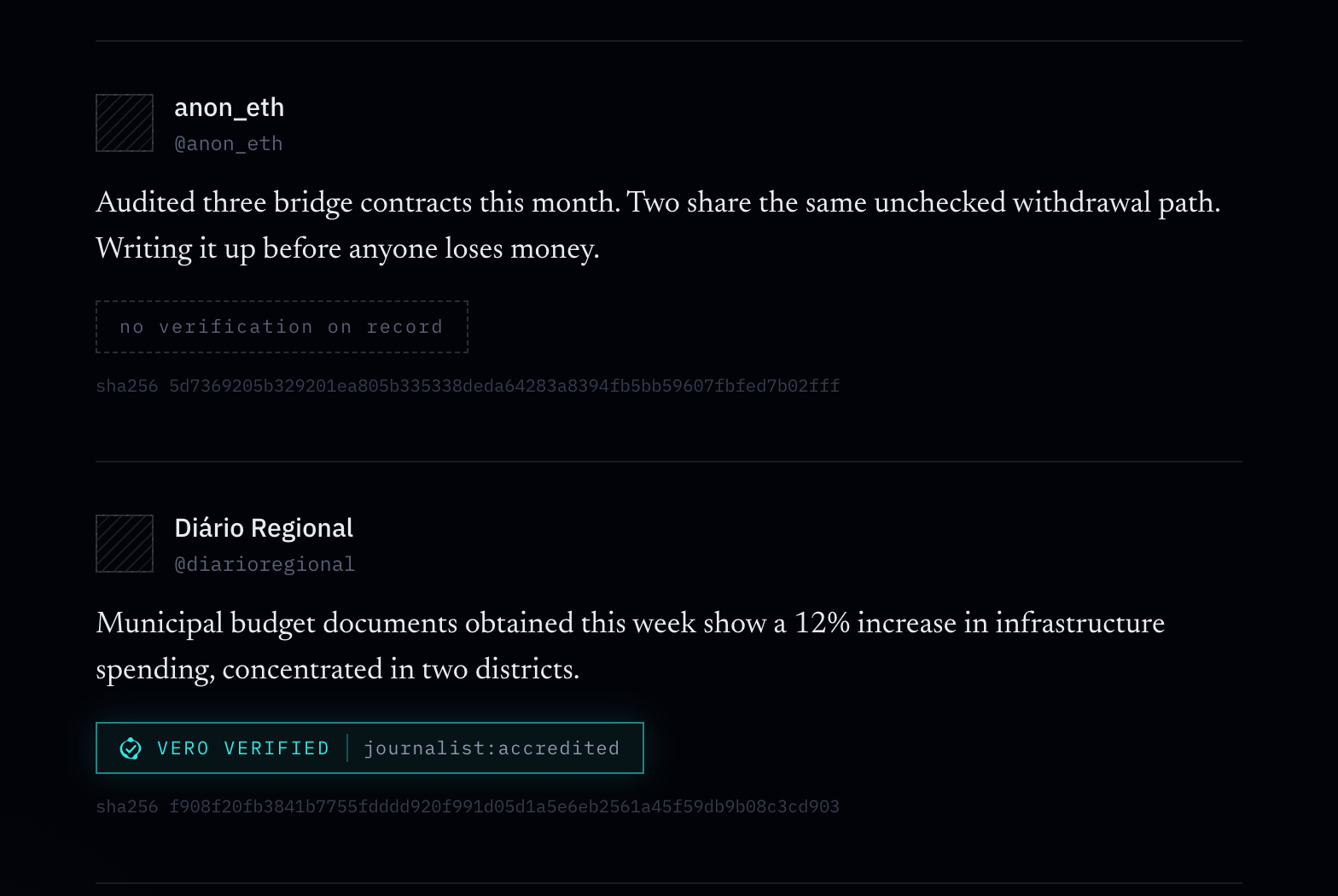
- Registry membership proven — without revealing which credential. Expiry enforced on-chain.
- Local Midnight devnet · block
5995
Roadmap
Roadmap
Aug 27 – Sep 16
- Concept, personas, competitive landscape
- Local dev stack operational
- Compact contract + end-to-end proof flow
- Merkle registry — one registrar per issuer type, expiry enforced
- Reader view — badge from live ledger state
- Contract test suite — 30 tests, no devnet needed
- Demo video
Sep 27 – Oct 17
- Wallet bridge — prove from the browser (DApp Connector ↔ midnight-js)
- Public-network deployment, with the reader view hosted
Oct 27 – Nov 16
- Credential revocation — withdraw one without disturbing the rest
- Governance beyond a single key — multisig or on-chain vote
Future
- Multiple credential types, verification policies
- Portable verification across websites and social feeds
- Browser integrations, APIs
Adoption
Two problems,
not one.
Who displays it. Web3-native publishing first — Mirror, Farcaster, Lens already assume a wallet and already publish under pseudonyms. Then individual publications, then the platforms.
Who issues it. The same world as A, first. Protocol foundations, ecosystem programmes and developer cohorts already decide who completed a programme and who contributes — Midnight's own Build Club is one. That is participation rather than licence: a different claim, and a different issuer type. Professional bodies follow — journalists' associations, medical councils, orders — publishing a judgement they already make.
- Why that order: ecosystem issuers and Web3-native publishing are the same population, so the first credential and the first place to show it arrive together instead of waiting for each other.
- Why before the ecosystem exists: a credentialed source who cannot safely publish under their own name wants this with or without a platform — and generated content made "a credentialed human stands behind this" a signal no checkmark can give.
One registrar per issuer — whoever grants a credential is the only one who can say whether it still holds. The contract has worked that way since Wave 1.
Team
Team
Rafaela Costa
Strategic UX/UI designer & product builder

the one credential in the demo registry — granted by the demo registrar, who is also her
Vero is a trust-signal design problem as much as a cryptography one — what a reader can understand at a glance decides whether any of the proof underneath matters. That is why it is built design-first.
Compact implementation written with AI-assisted tooling (Midnight Expert, Claude Code) and guidance from the Midnight Discord — which is what let a design-led author work at the contract level rather than around it.
Built for the Midnight Buildathon — Wave 1.